Showing posts with label coconut. Show all posts

Monday, March 15, 2010

Natural Products Expo West

The Natural Products Expo West took place Friday - Sunday, March 12 - 14 at the Anaheim Convention Center.  Expo West is always an amazing time, with so many awesome people coming together in one place to make new friends, reconnect with old ones, and generally celebrate life, while also accomplishing some business, and this year was no exception.  
I worked the show as an Athlete Representative for two of my sponsors, Manitoba Harvest and Sunfood and split my time at the show between their two booths, with a little time to walk around Sunday and check a couple other products.  Vapor Brothers threw a phenomenal party on Friday night in their hotel suite, with live sitar and drumming, 4 different vap stations, open bar, and catered by Au Lac!  Definitely one of the best gatherings I have ever attended in my life!  All of that was just warmups for the Julian Marley concert later that night, all time! Then Saturday night was the Organic Roots concert that takes place every year, another awesome show, and Sunday finished up the show with a dinner at Au Lac with the Sunfood team, and this incredible weekend became one future Expos will be compared to for years.
Working the Manitoba Harvest Hemp Foods booth with Certified Nutritionist Meghan Atkinson 
President and Co-Founder of Manitoba Harvest Mike Fata with the Founder of To-Go Ware Stephanie Bernstein, creator of reusable bamboo utensils that help you reduce your forkprint
Co-Owner of Sambazon Jeremy Black helping provide information on acai at their booth
Sunfood COO Brian Bowers with a raw cacao pod
Vapor Brothers party was one of the best ever!  Their booth rocked too!
Julian Marley sharing some irie vibes with the Natural Products family
Coconut Bliss and their vegan coconut milk dessert, while not raw a very worthy substitute for ice cream
Cole Meeker at Artisana with their mental coconut butter to sample
Sunfood team dinner at Au Lac to finish out one of the best Natural Products Expos yet!

Tuesday, February 23, 2010

Sprouted Coconut :)

The coconut palm (Cocos nucifera) is a common sight on most tropical islands, and is one of the most valuable plants for humans due to the multitude of uses it provides, which legitimizes its title as the "Tree of Life."  
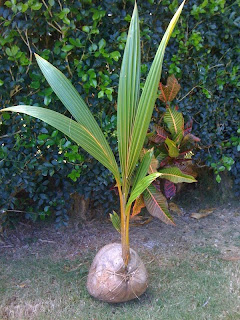
Sprouted coconut 
In fact, across the Polynesian archipelago of the South Pacific, every part of the coconut palm is utilized for a specific purpose, from food to shelter to tools.  The palm fronds are woven together to create everything from thatched roofs for island-style huts to floor mats and baskets.  The woody material in the trunk is used for building purposes, and the fibrous interior of the coconut husks is used in and around lava rock borders of tropical gardens.  The hard shell of the coconut is made into tools such as bowls and spoons, and chips of the shell make an excellent type of charcoal due to the slow-burning oils helping extend the duration of a fire.  All of these incredible uses and I haven't even mentioned how good they are to eat!

Young coconuts
The young green coconuts contain delicious and nutritious coconut water, an excellent source of rehydration and replenishment of electrolytes.  Coconut water is isotonic, meaning it has a similar electrolyte balance as blood plasma, and has been used by doctors as an intravenous solution and injected directly into the bloodstream to prevent dehydration, especially during emergency situations such as World War II where other intravenous solutions were either not available or in short supply.  The water sealed inside the coconut is sterile, free from pathogens, is non-allergenic, does not harm red blood cells, and is readily accepted by the body.  On many small tropical islands, coconut water is the only source of safe drinking water for the local inhabitants where rainfall is minimal.  The nutritional profile of coconut water includes containing a complex array of vitamins and minerals including high levels of potassium, chlorides, calcium, and magnesium, along with a variety of trace minerals, and a moderate amount of sodium, protein, and natural sugars.  Some of the health properties attributed to coconut water include its therapeutic effect on the urinary and reproductive systems, minimizing the effects of glaucoma, preventing the formation of atherosclerosis (hardening of the arteries), promoting digestion, and as an antioxidant.  The "fluid of life" living up to its name in a variety of ways.  
Opening the coconut husk
Removal of coconut from husk
As the coconut matures, the flesh or meat lining the inside of the shell begins to thicken and become tougher, and the water inside loses some of its flavor, while the green exterior begins to fade and becomes brown. The flesh of these mature coconuts are used to make coconut milk, thicker and whiter than the clear coconut water, as well as copra, which is the source of coconut oil production, and the major source of income for most small tropical islands.  
Botanically speaking, the "Tree of Life" is not really a tree, but instead is a member of the palm family Palmae.  These botanical characteristics include a woody trunk, perennial (as opposed to annual) growth, leaves folded like a fan, and along with grasses and lilies, the production of a single 'seed leaf' which classifies them as monocotyledons.  
Inside of a sprouted coconut
Coconuts can float for around three months in salt water until they get washed up on a sandy shoreline of some tropical beach, and despite the nutritionally-poor sands as a soil substrate to root in, with the presence of available fresh water the coconut will still sprout, and grow into a mature palm in about six years, thriving in this otherwise harsh environment.  Once a coconut sprouts, the water inside develops into a ball of foam, spreading out toward the flesh and filling up the interior of the coconut.  While I fully encourage allowing a sprouted coconut to grow into a mature palm, which can produce hundreds of new coconuts per year, in cases where space is lacking to allow a new coconut palm to form, harvesting the sprouted coconut for food is an incredibly delicious treat.  The ball of spongy white foam inside a sprouted coconut is such a delicious food that it has many different names, including coconut foam, the apple of the coconut, and coconut cotton candy, but I think the closest description that it resembles in taste and texture is coconut angel food cake.  Not only is this tropical delicacy nutritious and tasty, but it is also quite filling.  My first time sampling this beautiful blessing from nature and it instantly became one of my favorite foods!

Coconut angel food cake, so delicious!

Wednesday, February 17, 2010

Chocolate Maca Almond Haystacks

This was my first experiment at making a raw vegan chocolate recipe, but I knew I was going to make haystacks, chocolate and coconut are the most incredibly delicious combination!  
Chocolate comes from a tropical fruit that grows on trees called cacao, and inside the tough colorful shell of the cacao pods is a gooey white membrane of a deliciously unique sweet-tart flavor surrounding big brown cacao beans, the source of what most people know as chocolate. The cacao beans are sun dried and then separated into their two components, the bitter brown cacao powder and the lighter fat that is the cacao butter.  The whitish cacao butter is the source of white chocolate, and when the powder is added back in, the more cacao powder added the darker the chocolate becomes.  
South Pacific Cacao Pod
I have a few friends that have their chocolate recipes down to an art, so I asked a few critical questions to acquire the information gained from lifelong searches of knowledge, and for sharing that wisdom I am extremely grateful to Jacob Gilbert for his insight and experience. Chocolate production is truly an art form, as the trick to creating a great chocolate comes through an understanding of the tempering process, where the warm liquid mix cools into a solid at a specific rate of crystallization that creates a desired texture for the final chocolate treat. The key to raw food production is to maintain the temperature below 108 F in order to preserve vital living enzymes, so I keep my temps below 105 F.  The goal is to warm the cacao butter just enough to melt so that the cacao powder can be added back in for a smooth and creamy mixture, easily dissolving the powder into the butter.  Recipes can vary according to taste, with a larger ratio of cacao powder to cacao butter creating a darker chocolate.  
My personal recipe used all raw organic ingredients of the highest quality, ideal for creating the best quality treat, both for health (personal and planet) and flavor.  I use Sunfood Nutrition's raw organic cacao powder and cacao butter along with their agave nectar for a sweetener, along with their raw organic Italian almonds.  An incredible synergy complimenting the cacao is to include the superfood maca along side it for amazing energy and stamina, and I use only the highest quality grade and strain of maca, Lepidium Peruvianum Chacon, from Sol Raiz Organics.  Maca is a superfood grown in the highest elevation of the Peruvian Andes mountains, with this particular plantation located above 14,000 feet, and it is an incredible part of a vital and healthy life when consumed regularly, I personally swear by the stuff daily for increased energy and health.  In this recipe I added one of my favorite foods, Artisana's raw coconut butter, which I will eat by the spoonful because it is so amazing.  Also in this recipe was some lucuma powder, a fruit from Peru traditionally used in their ice cream providing a creamy maple caramel flavor, a bunch of shredded coconut, and a pinch of sea salt.  
Ingredients for CacaoStacks Recipe
The specific ratios pretty much come down to experimentation and personal preference, mixing the ingredients to create the desired taste and texture, but the amounts for cacao butter and powder are somewhat similar depending on how dark you want your chocolate, with agave nectar maybe half that, and small amounts comparatively of the coconut butter, maca, and lucuma, and the pinch of sea salt.  Once the mixture has reached the desired taste for a final product, add in a bunch of raw organic shredded coconut, the largest quantity of any one single ingredient, and a bunch of soaked and sprouted raw organic almonds. The almonds should be soaked and rinsed repeatedly a couple days ahead of time in order to remove the phytates or enzyme inhibitors which will create a more easily digestible and lighter tasting nut.  Once the final mix is ready you scoop it into whatever size treats you want by selecting that size cups or tray and then placing them in the fridge to cool.  In about an hour or so they should be ready.  Absolute heaven, enjoy :)

SOOOOO GOOOOOOOOOD :)